
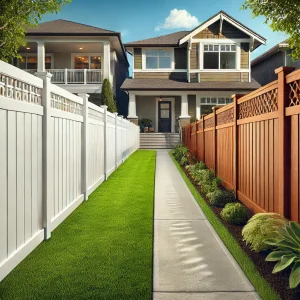
 Yes, vinyl fences often carry a higher upfront price tag than wood fences—but don’t let that scare you off! While wood might win the initial cost round, vinyl punches back with durability and low maintenance, making it a money-saver over time. Think of it like this: wood’s cheaper now, but vinyl’s built to last with fewer headaches. Let’s break down the costs—initial, long-term, and everything in between—to see which fence comes out on top for your wallet and your yard.
Initial Cost Comparison
Here’s where the sticker shock hits—vinyl usually costs more out of the gate:
- Vinyl: $20–$40 per linear foot—premium PVC with UV protection drives the price.
- Wood: $15–$30 per linear foot—cedar or pine is cheaper, though premium woods like redwood nudge closer to vinyl.
Example: A 100-foot vinyl fence might run $2,000–$4,000, while wood could be $1,500–$3,000—wood wins round one.
Why: Vinyl’s pre-assembled panels and thicker materials—see What is the wall thickness of a vinyl fence?—bump up the starting cost.
Long-Term Costs: Where Vinyl Shines
Over time, vinyl flips the script—here’s how it saves:
Maintenance Savings
- Vinyl: A rinse now and then—$10–$20 yearly—keeps it pristine—see What should I use to clean my vinyl fence?.
- Wood: Painting, staining, or sealing every 1–3 years—$100–$300 annually for 100 feet—adds up fast.
- Break-Even: Vinyl catches wood after about 6 years; if wood needs paint, it’s just 3 years.
Repair and Replacement
- Vinyl: Resists rot, bugs, and weather—20–30+ years with minimal fixes—check What is the average lifespan of a fence?.
- Wood: Prone to decay and pests—replacements every 10–20 years cost $1,500–$3,000 for 100 feet.
- Example: Vinyl’s $200 in upkeep over 10 years vs. wood’s $2,000–$3,000—vinyl wins big.
Full Scoop: See Vinyl Fencing vs. Wood Fencing – Long Term Costs.
Practical Tips
- Weigh Your Needs: Short-term budget? Wood’s fine. Long-term ease? Vinyl’s your pick.
- Hire Smart: A pro can break down costs—ask 25+ Essential Questions to Ask Your Fence Contractor.
- Match It Up: Vinyl gates too—see Can I get a matching vinyl gate?.
Final Thoughts
Vinyl fences start pricier than wood—$20–$40 vs. $15–$30 per foot—but their durability and low upkeep flip the cost game over time. No rot, no bugs, and no painting mean vinyl breaks even with wood in 3–6 years, then saves you cash for decades. It’s an investment that pays off. For more details, explore our vinyl fence guide or dig into costs at What is the average cost of a fence?. Ready to fence smart?
Related FAQs and Resources
- What type of fence is the most durable? – Vinyl’s edge shines.
- 7 Steps to Maintaining a Vinyl Fence – Easy upkeep tips.
- 25+ Essential Questions to Ask Your Fence Contractor – Get cost clarity.